
January 20, 2025: Optically Sorted Wines
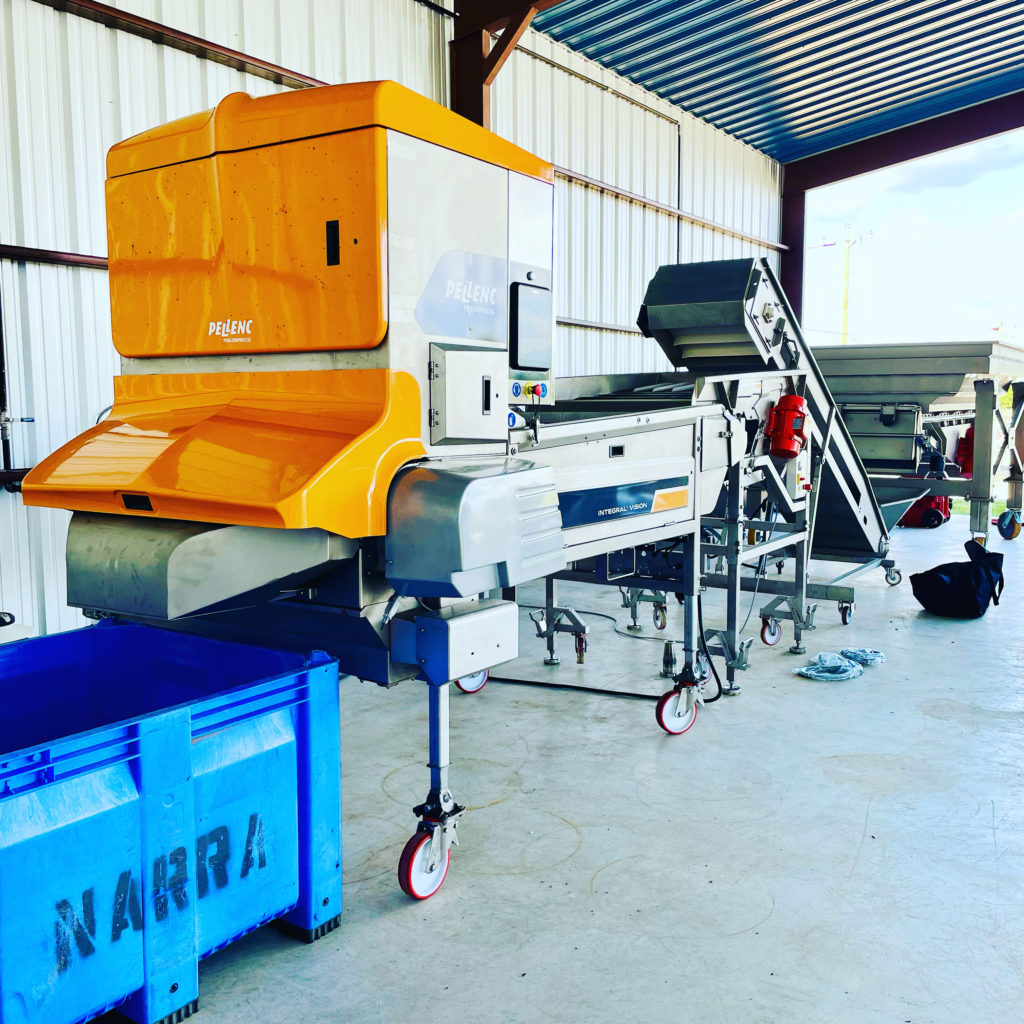
If you’ve come through our tasting room over the last few years, you’ve surely heard our team talk about optical sorting. In 2022 we were the first winery in Texas with an optical sorter, so it’s pretty central to our current winemaking program. We added an optical sorter to our winery with the sole purpose of crafting the highest quality wine ever in Texas. Now that we have three vintages under our belt with the optical sorter, we’ve released optically sorted wines, and have bottled a few more that are waiting to be released, let’s talk about what we’re seeing.
So first off, let’s have a quick recap on what an optical sorter is and where it comes into play for our winemaking program. Our family has 140 acres of vineyard planted in the Texas High Plains AVA in Brownfield, TX. The vineyard has been around since 2013 and is called Narra Vineyards (Nikhila’s maiden name). At our vineyard we utilize one of, if not the, best mechanical harvesters on the market, made by Pellenc. This harvester has a few things onboard that make using a mechanical harvester pretty great. First, the machine de-stems the grapes so that once the grapes arrive at a winery, there’s one less processing step that’s required. Second, the harvester has a series of rollers that are adjusted based on the varietal / vintage we’re harvesting so that there’s a rough sort on the grapes. Basically anything outside of a range of sizes doesn’t make it into our harvest bins. Our goal when harvesting grapes with this machine is to get whole berries (not burst open, minimal juice in bins) into our half ton bins as that will give us the best fruit to ultimately make into wine.
Once the grapes are harvested, they are typically loaded onto a refrigerated truck (the cold temperature slows fermentation and fends off spoilage bacteria) and make the ~5hr trek to our winery’s loading dock. From there we unload the bins and immediately start running grapes through our optical sorting line.
Ok now we’re to the optical sorter. So the grapes we receive in from our vineyard have already been mechanically sorter, so the fruit typically looks pretty good as-is. However, the optical sorter allows us to focus on making wine from the best of the best grapes. While we are working with thousands of pounds of grapes to make a wine, even fairly minimal material other than grapes (MOG – think stems, leafs) and imperfectly ripe grapes (e.g., raisins, underripe grapes) affect the flavor of the resulting wine. The optical sorting line works by us loading the bins of grapes we receive from our vineyard and then:
- Draining all the juice off the grapes (again we aim to have minimal juice from the vineyard – we want whole berries)
- Having small raisins and MOG fall through grates on a vibrating table while spreading the grapes out into a single layer
- Dropping the grapes onto the optical sorter’s blue belt, where the grapes move very rapidly (it’s kind of like a treadmill) and then a camera looks at all the plant material to decide what to keep. We control what’s kept vs. rejected with a tablet on the optical sorter. Anything the equipment decides should be rejected based on our criteria is blasted away with a jet of air, while good grapes go back into a clean harvest bin
Through this process we do lose grapes that would otherwise be made into wine. But the goal was always to make the best quality wine, so losing some grapes is worth it if we can improve the quality of the wine.
Now that we have a handful of 2022 vintage reds in bottles, what’s the verdict? We are incredibly pleased with the quality improvement. The wines that are made from optically sorted grapes are incredibly smooth and rich. The green characteristics that can have subtle negative impacts are gone. Tannins are well integrated. The quality improvement we have seen is something we could not do without the optical sorting line as the speed it works at cannot be realistically replicated by hand.